
Microchip ATSAMC21J18A-AUT: A Comprehensive Guide to the ARM Cortex-M0+ Based Microcontroller
The world of embedded systems is driven by the relentless pursuit of higher performance, greater efficiency, and enhanced connectivity. At the heart of countless industrial, consumer, and automotive applications lies the microcontroller (MCU), a compact integrated circuit designed to govern a specific operation. Among the plethora of options available, the Microchip ATSAMC21J18A-AUT stands out as a robust and versatile solution built on the powerful yet efficient ARM Cortex-M0+ core.
This MCU is a member of Microchip's SAM C21 family, which is engineered to deliver a high-performance, low-power architecture for a wide range of 3.3V applications. The ATSAMC21J18A-AUT is specifically packaged in a 64-pin TQFP, making it suitable for automated assembly processes common in high-volume manufacturing.
Architectural Prowess: The Cortex-M0+ Core
The defining feature of this microcontroller is its 32-bit ARM Cortex-M0+ processor, clocking at speeds up to 48MHz. This core is renowned for its exceptional energy efficiency, achieving high processing performance with a minimal silicon footprint and very low power consumption. It is an ideal choice for applications where power budget is a critical constraint. The core is complemented by a Single Cycle I/O access port, which allows for ultra-fast manipulation of GPIO pins, enabling highly responsive real-time control.
Key Peripherals and Features
The ATSAMC21J18A-AUT is far more than just a processor; it is a complete embedded ecosystem. Its rich set of peripherals is designed to interface with the analog world and communicate with other devices seamlessly.
Advanced Analog Capabilities: It features a 12-bit Analog-to-Digital Converter (ADC) with up to 20 channels, capable of sampling at 350 ksps. This is complemented by a 10-bit Digital-to-Analog Converter (DAC), two analog comparators, and an op-amp, making it exceptionally capable for precision sensor interfacing and analog signal processing.
Communication Interfaces: Connectivity is a strong suit. The MCU includes multiple SERCOM modules that can be individually configured as UART, I2C, or SPI interfaces. This flexibility allows designers to tailor the communication ports to the exact needs of their application. It also features a CAN FD (Flexible Data-rate) controller, which is critical for robust networking in automotive and industrial automation systems.
Timer and Control Logic: For control-oriented tasks, it is equipped with multiple Timer/Counters (TC), a Timer/Counter for Control (TCC) with support for PWM output, and a Peripheral Touch Controller (PTC) for implementing capacitive touch interfaces without external components.
Memory and Security: With 256KB of Flash memory and 32KB of SRAM, it provides ample space for complex application code and data handling. It also includes a Serial Wire Debug (SWD) interface for easy programming and debugging, along with security features like a Write Protection mechanism.
Target Applications
The combination of robust analog features, versatile communication options, and low-power operation makes the ATSAMC21J18A-AUT suitable for a diverse range of applications. Key areas include:
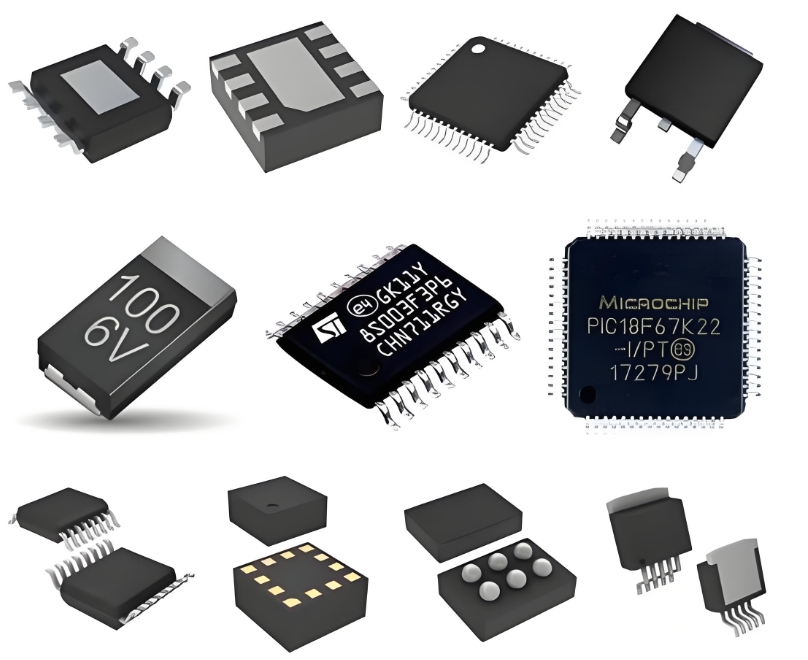
Industrial Automation: Motor control, PLCs, and sensor nodes.
Consumer Electronics: Appliances, touch panels, and gaming accessories.
Automotive: Body control modules, sensors, and lighting systems (leveraging its CAN FD and AEC-Q100 compliance).
Internet of Things (IoT): Battery-powered edge nodes requiring efficient processing and connectivity.
Development Ecosystem
Getting started with this MCU is supported by a comprehensive ecosystem. Microchip provides the MPLAB X Integrated Development Environment (IDE) and the Atmel START online tool for quick peripheral configuration and code generation. Hardware evaluation is facilitated by development boards like the SAM C21 Xplained Pro evaluation kit.
In summary, the Microchip ATSAMC21J18A-AUT is a highly integrated and flexible microcontroller that successfully balances performance, power efficiency, and peripheral integration. Its ARM Cortex-M0+ core provides a modern and efficient processing foundation, while its extensive set of analog and communication peripherals makes it a compelling choice for designers tackling complex embedded challenges in industrial, automotive, and IoT markets.
Keywords:
1. ARM Cortex-M0+
2. Microcontroller (MCU)
3. CAN FD
4. Peripheral Touch Controller (PTC)
5. Low-Power

